-
E-mail
Austin120521@outlook.com -
E-mail
sales@jujiuhouse.com -
Telefòn
+86-17864099991 -
Telefòn
+86-17854044442
- English
- Chinese
- French
- German
- Portuguese
- Spanish
- Russian
- Japanese
- Korean
- Arabic
- Irish
- Greek
- Turkish
- Italian
- Danish
- Romanian
- Indonesian
- Czech
- Afrikaans
- Swedish
- Polish
- Basque
- Catalan
- Esperanto
- Hindi
- Lao
- Albanian
- Amharic
- Armenian
- Azerbaijani
- Belarusian
- Bengali
- Bosnian
- Bulgarian
- Cebuano
- Chichewa
- Corsican
- Croatian
- Dutch
- Estonian
- Filipino
- Finnish
- Frisian
- Galician
- Georgian
- Gujarati
- Hausa
- Hawaiian
- Hebrew
- Hmong
- Hungarian
- Icelandic
- Igbo
- Javanese
- Kannada
- Kazakh
- Khmer
- Kurdish
- Kyrgyz
- Latin
- Latvian
- Lithuanian
- Luxembou..
- Macedonian
- Malagasy
- Malay
- Malayalam
- Maltese
- Maori
- Marathi
- Mongolian
- Burmese
- Nepali
- Norwegian
- Pashto
- Persian
- Punjabi
- Serbian
- Sesotho
- Sinhala
- Slovak
- Slovenian
- Somali
- Samoan
- Scots Gaelic
- Shona
- Sindhi
- Sundanese
- Swahili
- Tajik
- Tamil
- Telugu
- Thai
- Ukrainian
- Urdu
- Uzbek
- Vietnamese
- Welsh
- Xhosa
- Yiddish
- Yoruba
- Zulu
- Kinyarwanda
- Tatar
- Oriya
- Turkmen
- Uyghur




Luxury 40ft expandable container house tech specs?
2026-03-31
- Luxury 40ft Expandable Container House Tech Specs: What the Brochures Don’t Tell You
- The Frame & Expansion Mechanism: Where Most Failures Begin
- Cladding & Insulation: The Performance Deception
- Interior Build-Out & MEP Rough-Ins
- On-Site Integration & The Hidden Specs
- The Bottom Line: Interpreting the Numbers
Luxury 40ft Expandable Container House Tech Specs: What the Brochures Don’t Tell You
Everyone asks for the tech specs sheet first. I get it. But if you’re just comparing numbers on paper—dimensions, steel gauge, R-values—you’re already missing half the story. The real specs for a luxury 40ft expandable unit are buried in the execution, the site headaches, and the compromises you never see coming until the container is craned onto your foundation. Let’s talk about what that document should actually say.

The Frame & Expansion Mechanism: Where Most Failures Begin
The core isn’t the container; it’s the dilola system. A standard 40ft high-cube gives you about 320 sq ft. Expanded, you’re aiming for what, 600-650 sq ft? The magic—and the misery—is in the slide-out sections. I’ve seen too many designs rely on basic rack-and-pinion or hydraulic rams that buckle under uneven load after a few cycles. The spec should list the actuator type, its IP rating (IP65 minimum for coastal areas), and its fail-safe position. Does it have a manual override when power fails? You’d be surprised how many don’t.
Then there’s the seal. The expansion gap is a thermal bridge and a water magnet. The tech spec must detail the triple-seal system: a primary bulb seal, a secondary brush seal, and an internal thermal break. I recall a project in British Columbia where we used a competitor’s unit; the client reported drafts and condensation along the entire expansion joint within a month. The spec sheet claimed fully insulated expansion. It was, technically, but the insulation wasn’t continuous—a classic oversight.
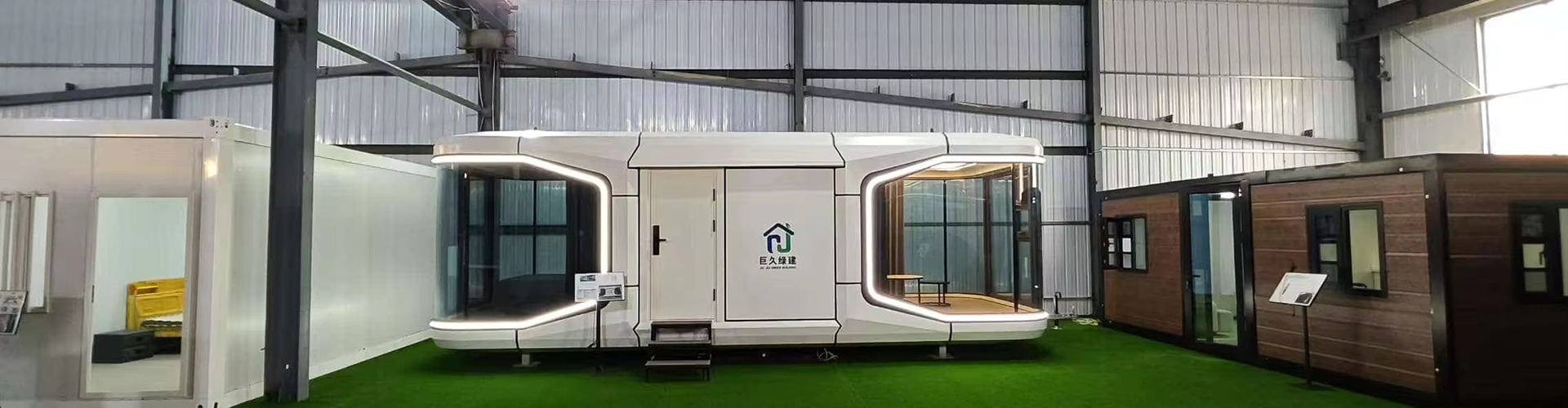
Frame steel matters, but the treatment matters more. 345MPa Corten steel is standard, but the coating isn’t. A full hot-dip galvanizing after fabrication is non-negotiable for longevity, especially at the cut-outs for expansion. Some factories just spray-paint over welds. Check for a mill certificate. A company like Shandong Jujiu entegre lojman Co, Ltd often provides this traceability, which is a good sign. Their portfolio at jujiuhouse.com shows they handle the integrated engineering from design to install, which usually means better control over these critical details.
Cladding & Insulation: The Performance Deception
They’ll tout high-efficiency insulation. Dig deeper. For a luxury finish meant for four-season use, you’re looking at a composite panel system, not batt insulation stuffed between studs. The best setups I’ve worked with use a continuous layer of rigid PIR or rockwool panels (100mm min.) sandwiched between the exterior corrugated metal and an internal service cavity. The R-value should be stated for the entire wall assembly, not just the insulation material. An R-25 whole-wall is a decent target for most temperate climates.
Exterior cladding is another trap. A sleek, flat aluminum composite panel looks great but can dent and is hell to repair. Fiber cement boards are more resilient but heavier. The spec should include the substrate—usually a ventilated rain screen system—and the fastener type. Stainless steel, not galvanized. I learned that the hard way on a seaside install where salt spray corroded the fasteners in two years, leading to panel rattles.
Roof assembly is critical. A slight pitch (at least 5%) for drainage, EPDM or TPO membrane, and again, continuous insulation. I once had a client insist on a green roof on an expandable unit. The structural load was fine, but we had to massively reinforce the expansion mechanism to handle the extra dead load when retracted. That’s never on a standard spec sheet.
Interior Build-Out & MEP Rough-Ins
This is where luxury is defined. Tech specs often list finishes—porcelain tile, solid wood cabinetry—but the crucial info is in the rough-ins. Electrical: Are conduits pre-run in the floor and ceiling for smart home systems? Is there a designated chase for plumbing stacks between expanded modules? Water and waste lines must have flexible connections or strategic placement to avoid shearing during expansion/contraction.
HVAC is a big one. A single mini-split often struggles with the elongated space post-expansion. The spec should account for a multi-zone system or at least pre-wired/pre-piped for a second head. Ducted systems are tricky due to ceiling cavity constraints. We typically design a small, centralized air handler in a mechanical closet with low-profile ducting.
Consider the ceiling height. A standard high-cube is about 9’6 internally. With a composite roof/floor assembly and a finished ceiling, you might lose a foot. That’s a palpable difference. Good specs will state clear interior height after finish. For a true luxury feel, we aim to keep it above 8’10.
On-Site Integration & The Hidden Specs
The most important spec might be the installation manual. How many crane pick points? What’s the required foundation tolerance? I’ve seen beautifully engineered houses sit on a slab that’s out of level by 2 inches, making expansion impossible. The spec should include the maximum allowable foundation gradient—often less than 1/4 inch over 40 feet.
Utility connections are another gray area. The unit should have a centralized utility core with clearly labeled, easily accessible ports. Look for specs on the entry boots for electrical and plumbing—they must be weatherproof and allow for movement. A common failure point is the main electrical feed; it needs a generous service loop or a plug-and-play connector rated for the amperage.
Finally, think about future service. Can you access the expansion mechanism gears for lubrication? Is there an access panel to the main plumbing shut-offs? A good set of specs reads like a long-term maintenance guide. Companies that focus on integrated solutions, like Jujiu, which as an industrial enterprise integrating the research and development, design, optimization, production, processing, sales and installation, tend to have more practical specs because they’ve dealt with the installation fallout themselves.

The Bottom Line: Interpreting the Numbers
So, when you look at a spec sheet for a luxury 40ft expandable container house, don’t just read it. Interrogate it. If it lists fully insulated, ask for the assembly detail drawing. If it says high-end fixtures, ask for the brand and model to verify lead time and serviceability. The weight is a key number: a fully finished unit shouldn’t exceed 15 tons for transport logistics.
The true test is in the boundary conditions—the specs for extreme heat, cold, wind, and repeated mechanical cycling. Ask for the test reports on the expansion system. Has it been cycled 500 times? 1000? That’s the difference between a prototype and a product.
In the end, the best tech specs are a transparent record of problems already solved. They acknowledge the complexities of site work, climate, and human use. They’re less a sales document and more a builder’s set of notes. That’s what you’re really after—the confidence that someone has already stood in the mud, watched the unit expand for the hundredth time, and fixed what broke. That’s the unlisted luxury spec.