-
E-mail
Austin120521@outlook.com -
E-mail
sales@jujiuhouse.com -
Telephone
+86-17864099991 -
Telephone
+86-17854044442
- Chinese
- French
- German
- Portuguese
- Spanish
- Russian
- Japanese
- Korean
- Arabic
- Irish
- Greek
- Turkish
- Italian
- Danish
- Romanian
- Indonesian
- Czech
- Afrikaans
- Swedish
- Polish
- Basque
- Catalan
- Esperanto
- Hindi
- Lao
- Albanian
- Amharic
- Armenian
- Azerbaijani
- Belarusian
- Bengali
- Bosnian
- Bulgarian
- Cebuano
- Chichewa
- Corsican
- Croatian
- Dutch
- Estonian
- Filipino
- Finnish
- Frisian
- Galician
- Georgian
- Gujarati
- Haitian
- Hausa
- Hawaiian
- Hebrew
- Hmong
- Hungarian
- Icelandic
- Igbo
- Javanese
- Kannada
- Kazakh
- Khmer
- Kurdish
- Kyrgyz
- Latin
- Latvian
- Lithuanian
- Luxembou..
- Macedonian
- Malagasy
- Malay
- Malayalam
- Maltese
- Maori
- Marathi
- Mongolian
- Burmese
- Nepali
- Norwegian
- Pashto
- Persian
- Punjabi
- Serbian
- Sesotho
- Sinhala
- Slovak
- Slovenian
- Somali
- Samoan
- Scots Gaelic
- Shona
- Sindhi
- Sundanese
- Swahili
- Tajik
- Tamil
- Telugu
- Thai
- Ukrainian
- Urdu
- Uzbek
- Vietnamese
- Welsh
- Xhosa
- Yiddish
- Yoruba
- Zulu
- Kinyarwanda
- Tatar
- Oriya
- Turkmen
- Uyghur




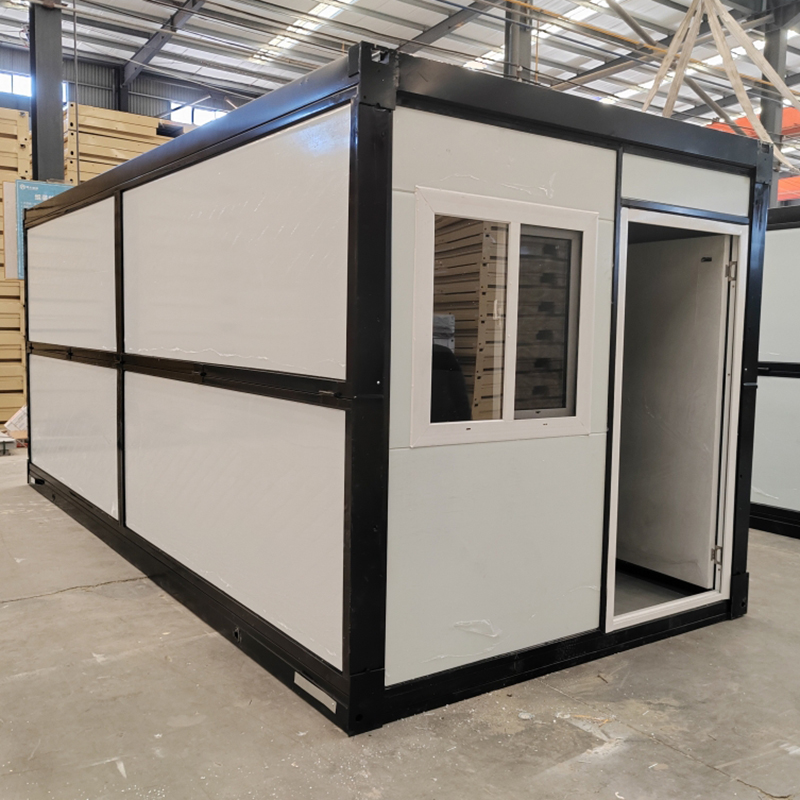
Fold Out Container for Space-Saving Storage and Easy Transport
2026-08-12
Fold Out Container: The Real-World Answer to Tight Spaces and Tight Deadlines
You’re standing on a remote campsite with 48 hours to set up guest accommodation. Or you’re managing a construction site where storage space vanishes daily. Or you’re launching a pop-up café in a city alley — no crane, no foundation, no time. That’s when a fold out container stops being a concept and becomes your only viable solution.
We’ve deployed over 1,200 units across 17 countries — not as prototypes, but as working infrastructure. What we learned isn’t theoretical: a fold out container must survive real-world stress — wind gusts above 65 km/h, monsoon-level rain, uneven ground, and repeated assembly/disassembly by non-specialist crews. It must open fully in under 12 minutes. It must lock rigidly — no wobble, no creak, no compromise on structural integrity. And it must ship flat-packed without damage to hinges, seals, or frame geometry. That’s the baseline. Not the promise. The requirement.
Why “Fold Out” Beats “Foldable” in Practice
Most buyers confuse “foldable” with “fold out.” Big difference. Foldable units often rely on soft-wall panels, fabric joints, or single-axis hinges — fine for temporary signage or lightweight shelters. A true fold out container uses dual-wing, heavy-duty steel hinge systems anchored to reinforced corner posts. Think of it like opening a book — but one built to ISO 1496-1 container strength standards.
In actual field use, this means:
Some argue that welded-frame containers are more durable. True — if you never move them. But when relocation is part of the plan — and it almost always is — weld fatigue, transport damage, and site adaptation costs add up fast. A fold out container trades static permanence for dynamic resilience. And in today’s project timelines, that trade-off pays off every time.
What Actually Breaks — and How to Prevent It
Our service logs show three recurring failure points — all avoidable with upfront clarity:
Hinge misalignment after transport: Caused by improper stacking or unsecured tie-downs. Fix: All units ship with custom cradles and torque-spec fasteners. We include alignment pins — not suggestions.
Seal compression loss in sub-zero conditions: Standard EPDM seals harden below –15°C. Fix: Units destined for cold climates get silicone-blend seals rated to –40°C — specified at order, not assumed.
Electrical conduit kinking during folding cycles: Happens when wiring runs aren’t routed through flexible armored conduit with ≥8% bend radius allowance. Fix: Every unit ships with pre-tested, strain-relieved cable pathways — mapped in the installation manual with photo callouts.
We don’t list “optional upgrades.” We build for the worst-case scenario first — then let customers de-select, not retrofit.
Real Deployment Scenarios — Not Brochure Shots
A luxury resort in Bali needed staff housing near the beach — no excavation permitted, strict coastal erosion regulations, 3-week timeline. They chose a dual-wing fold out container with elevated deck framing and corrosion-grade stainless hinges. Installed on screw piles in 14 hours. No crane. No dust.
A municipal disaster response team in Sichuan ordered 42 units for flood relief. Key requirements: rapid sanitation setup, wheelchair-accessible layout, and interoperability with existing water tanks. We modified the base model with reinforced toilet module interfaces and universal coupling ports — delivered in 9 days, including customs clearance.
A tech startup in Berlin used five units as modular R&D labs. They needed 220V/380V dual supply, EMI shielding, and acoustic insulation exceeding STC 52. We integrated shielded conduits, floating floor layers, and factory-calibrated grounding — all validated with on-site EMF and decibel readings before shipment.
These weren’t exceptions. They were the minimum spec — because real users demand real performance, not marketing claims.
Choosing Your Fold Out Container — Five Non-Negotiable Checks
Before signing any quote, verify these — in writing:
A fold out container is only as reliable as its weakest link — and that link is rarely the steel. It’s the hinge tolerance. The seal compression curve. The installer’s familiarity with torque specs. Choose accordingly.
At SHANDONG JUJIU INTEGRATED HOUSING CO., LTD, we treat each unit as mission-critical infrastructure — not disposable hardware. Our production line runs ISO 9001-certified workflows. Our quality checkpoints happen at seven stages — from raw material tensile testing to final thermal imaging of seam welds. We don’t just ship containers. We ship deployable certainty.
The future of spatial efficiency isn’t about building bigger. It’s about deploying smarter — with precision, speed, and zero compromise on function. That starts with choosing a fold out container engineered for what happens next — not just what’s drawn on paper.